
26 November 2025
SolGold plc
("SolGold" or the "Company")
Announces High-Confidence Potential 60.2 Mt Near-Surface Starter Pit at
Tandayama-América Strengthens the Cascabel Development Strategy
SolGold plc (LSE: SOLG) is pleased to announce significant progress in evaluating a potential near-surface starter-pit opportunity at the Tandayama-América ("Tandayama") deposit (Figure 1) and an update regarding the Mineral Resource Estimate ("MRE")(Table 2). Recent internal studies completed with Mining Plus Pty Ltd have defined a 60.2 Mt potential open-pit at a grade of 0.43% CuEq, demonstrating strong potential to support the early development sequence at Cascabel ("Cascabel" or the "Project").
The potential 60.2 Mt resource shell is characterised by shallow porphyry copper-gold mineralisation, a very low strip ratio, and a high proportion of Measured resource, designed to provide a high-confidence source of early mill feed. This scenario is a compelling option that complements the planned longer-term ramp-up of the Alpala underground mine by providing earlier production and cash flow, thereby enhancing the Project's overall development.
CEO Dan Vujcic commented:
"A Tandayama starter operation would provide SolGold a tangible opportunity to accelerate the Cascabel Project. The near-surface nature of the deposit's strong grade profile, combined with the high proportion of Measured material in the 60.2 Mt case, provides an attractive early-mining option that fits well into the development pathway. Optimising the overall Cascabel plan ensures smoother permitting and infrastructure decisions to accommodate the full range of potential outcomes, creating near-term returns for our shareholders while significantly de-risking potential sub-level cave and block cave operations at Alpala in the future."
60.2 Mt Potential Starter Pit: A High-Confidence Early Phase
The optimised 60.2 Mt case contains material grading 0.43% CuEq at a 0.16% CuEq cut-off, supported by extensive drilling and robust geological continuity, and a low waste-to-ore stripping ratio of 0.63:1 (Figure 2). Approximately 45 Mt of 0.46% CuEq is classified as Measured, representing 75% of the shell, with the remaining tonnage in the Indicated category (Figures 3 -6). The contained metal totals 259 Kt CuEq, including 138 Kt of copper and 0.44 Moz of gold (Table 1).
Next Steps
There remains significant potential to expand the size and grade of the potential 60 Mt starter-pit. Next steps include:
· Process and integrate outstanding drilling data and assays, including over 1,400 metres of recently completed drilling.
· Mobilise two additional drill rigs to strengthen and expand the Tandayama drilling program.
· Continue geotechnical and metallurgical sampling to support future scenario refinement and early-stage engineering inputs.
· Incorporate revised drilling and modelling outputs into broader infrastructure, permitting, and mine-plan development work.
· Update timeline and provide initial view of standalone project economics of the potential Tandayama open pit, including detailed design and mine sequencing.
Integration Within Larger Open-Pit Planning Envelope
In parallel with the potential starter-pit assessment, the Company has continued to evaluate larger staged pit shells (20 Mt, 60 Mt, 220 Mt, and the full 576 Mt Reasonable Prospects for Economic Extraction ("RPEEE") envelope to ensure that infrastructure layouts and permitting considerations accommodate the full range of potential long-term development options (Figures 3-6). These scenarios are planning tools only and do not represent updated Mineral Resource Estimates, but they provide essential context for mine-design optimisation and sequencing.
Cross-Section and Geological Context
Cross-sectional analysis (Figure 7) highlights the continuity of mineralisation captured within the 60 Mt shell and its favorable geometry relative to the larger RPEEE limit. The shallow depth and concentration of the classified material support the potential for an efficient, scalable starter mining phase within the broader Cascabel development framework.
Table 1. 60 Mt Resource Optimisation
| Cut-off Grade (CuEq%) |
Resource Category |
Tonnage (MT) |
Grade |
Contained Metal |
||||
| CuEq (%) |
Cu (%) |
Au (g/t) |
CuEq (Kt) |
Cu (Kt) |
Au (Moz) |
|||
| 0.16 |
Measured |
45.2 |
0.46 |
0.24 |
0.25 |
206.5 |
109.2 |
0.36 |
| Indicated |
15.1 |
0.35 |
0.19 |
0.18 |
52.5 |
29.2 |
0.09 |
|
| Measured + Indicated |
60.2 |
0.43 |
0.23 |
0.23 |
259 |
138.4 |
0.44 |
|
Various optimized shells within the optimized resource reviewed with Mining Plus help refine the range of potential open-pittable resources and are being used to inform potential sequencing options, mill-feed planning, and integration with underground development.
Current analysis indicates that several areas of the deposit are more favorable, exhibiting near-surface copper-equivalent grades that support the potential for early, lower-strip-ratio open-pit mining. Optimisation shells (Figure 4) identify how resource development could be sequenced depending on tonnage requirements. These shells also demonstrate that Tandayama could potentially be developed in successive stages, ranging from smaller pits targeting the highest-value material first, expanding to larger, long-term footprints, providing flexibility aligned with economic and operational goals.
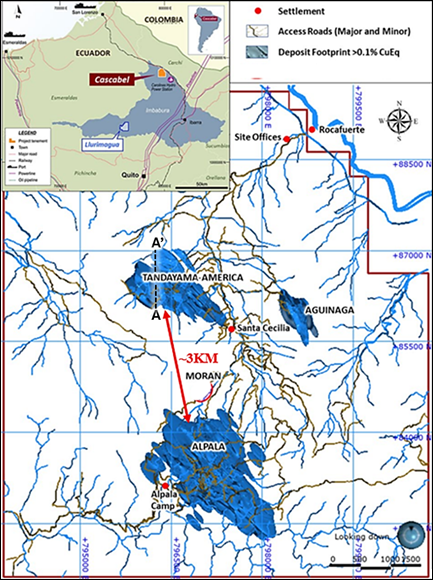
Figure 1. Site plan showing Project Location, and the porphyry deposits at the Cascabel Project, defined at the 0.1% CuEq level (blue). Section A-A' (referred to herein) is shown at the Tandayama-America deposit.
Table 2. Mineral Resource Statement: Effective date 26 November 2025
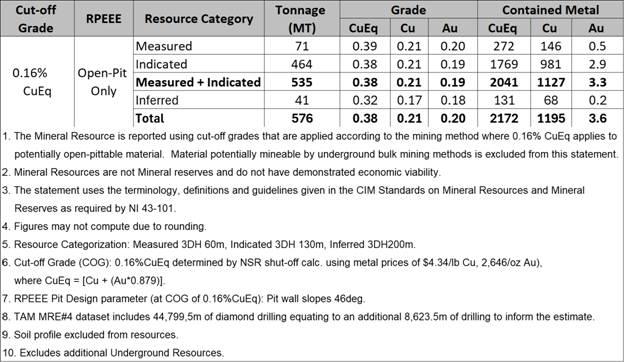
The Open-Pit Mineral Resource at the Tandayama deposit is updated to 535Mt @ 0.38% CuEq for 1.12Mt Cu, and 3.3Moz Au in the Measured plus Indicated categories, with an additional 41Mt @ 0.32% CuEq in the Inferred category (Table 1).
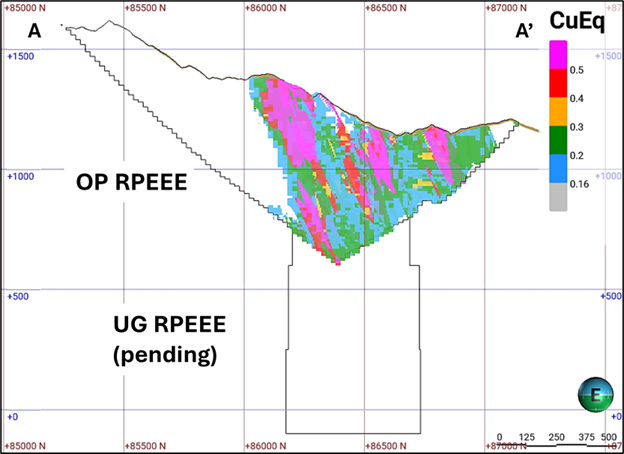
Figure 2. Section A-A', looking west, showing Tandayama Open Pit RPEEE ("Reasonable Prospects for Eventual Economic Extraction") footprint used to define the maximum potential mining envelope for mineral resources extractable by open-pit mining methods.
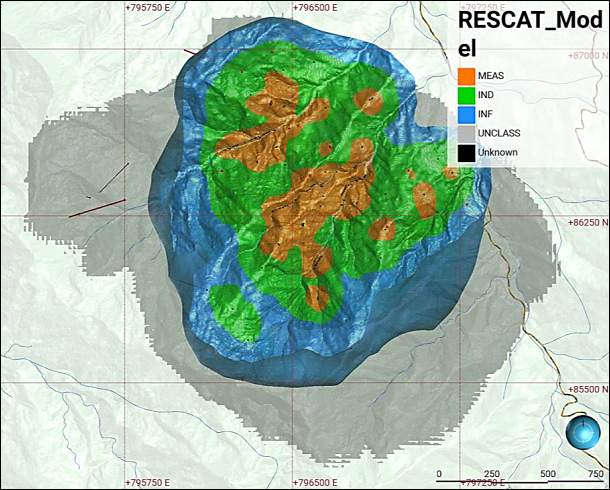
Figure 3. Tandayama Resource Classification Map. 3-D view map showing the distribution of Measured (orange), Indicated (green), and Inferred (blue) classification over the conceptual RPEEE open-pit footprint. The figure illustrates the clustering of higher-confidence material toward the central and western portions of the deposit, highlighting potential early extraction areas and demonstrating how near-surface classified zones may support early open-pit development scenarios.
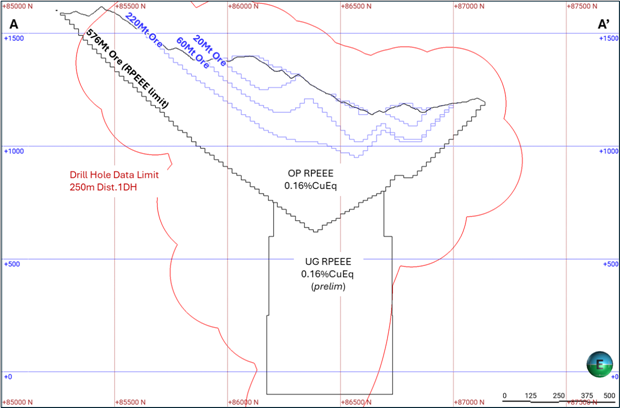
Figure 4. Section A-A', looking west, showing Tandayama near-surface resource shells (20 Mt, 60 Mt, 220 Mt) looking NW. These cases highlight the optionality for potential early development, the presence of near-surface material, and the potential for lower strip ratios in the initial stages. Three resource scenarios were identified as optimal within the RPEEE area at a 0.16% CuEq Cut-Off.
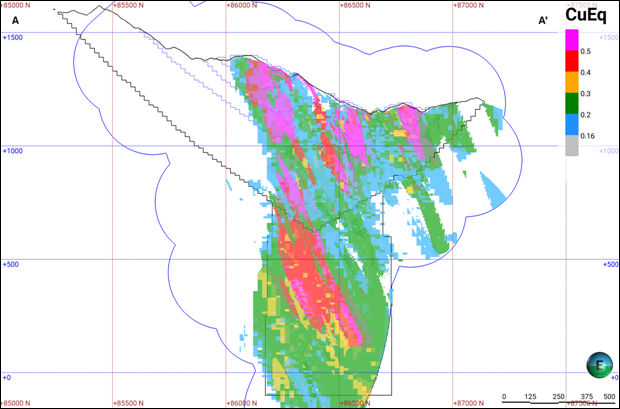
Figure 5. Section A-A', looking west, showing Tandayama Grade Distribution Map - block model CuEq% grades. Near-surface copper, gold, and copper-equivalent grades inform potential starter-pit and sequencing options.
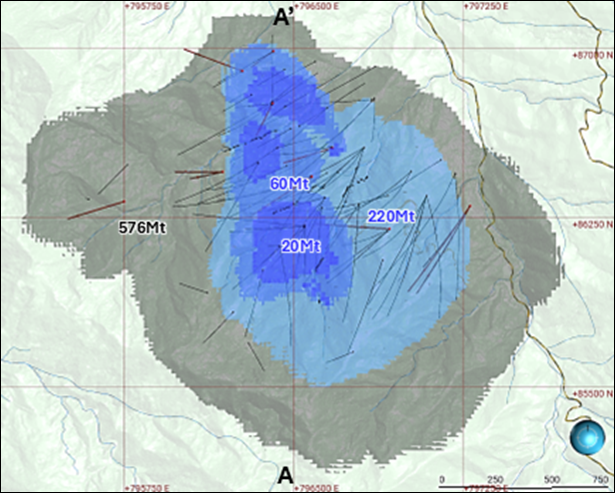
Figure 6. Conceptual Nested Resource Shells at Tandayama (20 Mt, 60 Mt, 220 Mt).
Plan-view map illustrating preliminary staged open-pit development scenarios within the broader RPEEE planning shell. The shaded blue tonnage envelopes (20 Mt, 60 Mt, and 220 Mt) highlight potential resource shells targeting potential higher-value, near-surface material in early phases, followed by larger mining stages as development progresses. These scenarios demonstrate the flexibility available for sequencing options and the potential for Tandayama to provide early mill feed during the Alpala Block Cave ramp-up period.
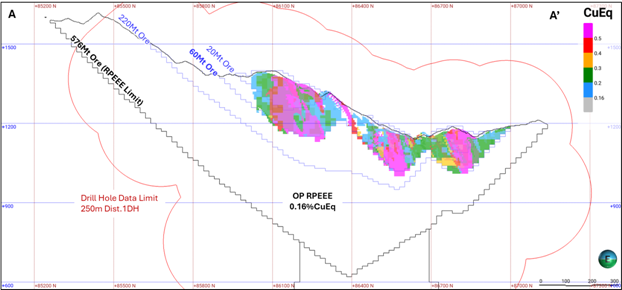
Figure 7. Section A-A', looking west, showing the 60 Mt resource shell relative to the 576 Mt RPEEE envelope and other nested optimization cases (20 Mt and 220 Mt optimisation cases). The coloured blocks represent CuEq% block model grades included in the 60 Mt scenario, illustrating the continuity and depth extent of mineralized volumes considered for early production sequencing. This resource shell is largely measured and indicated, and is near surface, presenting an early development option at very low strip ratios.
The Company has compared the previously reported 2023 open-pit Mineral Resource Estimate for Tandayama (MRE#3, November 11, 2023)1 with the November 2025 conceptual planning resource prepared by Mining Plus. The new modelling introduces a Measured category for the first time, adds 43 Mt to the combined Measured and Indicated tonnage, and increases contained CuEq metal by approximately 20%. These changes reflect updated drilling, refined geological modelling, and revised economic parameters. Minor decreases in Indicated and Inferred tonnage largely reflect reclassification into Measured.
CONTACTS
| Dan Vujcic Chief Executive Officer
|
Tel: +41 (0) 41 710 04 28
|
| Canaccord Genuity Limited (Broker) James Asensio / Charlie Hammond
|
Tel: +44 (0) 20 7523 8000 |
ABOUT SOLGOLD
SolGold is a leading resources company focused on the discovery, definition, and development of world-class copper and gold deposits, and continues to strive to deliver objectives efficiently in the interests of its shareholders.
The Company operates with transparency and in accordance with international best practices. SolGold is committed to delivering value to its shareholders while simultaneously providing economic and social benefits to impacted communities, fostering a healthy and safe workplace, and minimizing environmental impact.
SolGold is listed on the London Stock Exchange (LSE: SOLG).
See www.solgold.com for more information. Follow us on X @SolGold_plc.
NOTES TO EDITORS
Mineral Resource Estimate
The TAM Mineral Resource Estimate Update (TAM MRE#4) dataset comprised 44.799.5m of diamond drilling from holes 1-77, as well as 476.4m of surface rock-saw channel sampling from 73 outcrops. The estimate utilized 43.462.4m of assay data available, with 1496.4m of assays pending at the time of the data cut-off. This equates to an additional 8,623.5m of drilling used to inform geology models, and an additional 6,838m of assays used to inform the estimation, from the previously announced TAM open-pit resource.
The estimation process followed the Canadian Institute of Mining, Metallurgy and Petroleum ("CIM") "Estimation of Mineral Resources and Mineral Reserves Best Practice Guidelines" ("CIM, 2019"). The Mineral Resource Estimate is stated in accordance with CIM Definition Standards ("CIM, 2014").
Ordinary Kriging ("OK") was run in three search passes and with soft boundaries using Leapfrog Edge software. The estimation of Cu and Au was confined within 3D estimation domains, which were based on the combination of two 3D wireframe interpretations:
Model validation tests have not exhibited any material bias between the input composite grades and the block model estimates.
The TAM deposit shares the same geological and structural setting as the Alpala deposit. Mineralisation is hosted within a complex of middle to late-Eocene (Bartonian) hornblende-bearing diorites, quartz diorites and intrusive breccias that intrude volcanic host rocks to form a complex of stocks, dykes, and breccia pipes.
The trend of mineralisation throughout the TAM deposit is defined by a northwest trending intrusive complex inclined steeply towards the northeast. Surface mapping data was supported by structural measurements taken from orientated drill core provided data from intrusive contacts and B-type quartz veins.
Copper and gold mineralisation is intimately associated with porphyry style B-type quartz-chalcopyrite veins and stockworks, centred upon an early-mineral causal quartz-diorite intrusion (QD10), and cut by a series of intra-mineral, late-mineral and post-mineral stocks dykes and breccias of diorite, hornblende diorite, and quartz diorite.
Intrusions have emplaced episodically such that each subsequent intrusion has introduced mineralising fluids (and subsequent arrays of mineralised veins) into the TAM system, and/or remobilising and enriching existing mineralisation or contributed to localised overprinting of pre-existing mineralisation.
The geological character of the porphyry stocks / dykes encountered through drilling to date indicate a well-preserved porphyry system with significant potential for greater depth extent. Individual mineralised porphyry dykes are observed to have emplaced within a vertical column of over 1,000m.
The full size and tenor of the TAM system has not yet been tested. Mineralisation remains open to the south and east and at depth.
Reasonable Prospects for Eventual Economic Extraction
The cut-off grades used for reporting have been based on up to date third party metal price research, forecasting of Cu and Au prices, and a cost structure from mining studies currently being reviewed. Costs include mining, processing and general and administration ("G&A"). Net Smelter Return ("NSR") includes metallurgical recoveries and off-site realisation ("TC/RC") including royalties and utilising consensus metal prices.
Cut-off grades have been developed independently for open pit mining methods and underground bulk mining methods. The cut-off grade for potentially open pittable material has been calculated at 0.16% CuEq using a copper equivalency factor of 0.879.
QUALIFIED PERSON
The scientific and technical disclosure included in this news release has been reviewed and approved by Mr. Santiago Vaca (M.Sc. P.Geo.), a Qualified Person as defined under National Instrument 43-101 - Standards of Disclosure for Mineral Projects.
CAUTIONARY NOTICE
News releases, presentations and public commentary made by SolGold plc (the "Company") and its Officers may contain certain statements and expressions of belief, expectation or opinion which are forward looking statements, and which relate, inter alia, to interpretations of exploration results to date and the Company's proposed strategy, plans and objectives or to the expectations or intentions of the Company's Directors, including the plan for developing the Project currently being studied as well as the expectations of the Company as to the forward price of copper. Such forward-looking and interpretative statements involve known and unknown risks, uncertainties, and other important factors beyond the control of the Company that could cause the actual performance or achievements of the Company to be materially different from such interpretations and forward-looking statements.
Accordingly, the reader should not rely on any interpretations or forward-looking statements, and save as required by the exchange rules of the TSX and LSE or by applicable laws, the Company does not accept any obligation to disseminate any updates or revisions to such interpretations or forward-looking statements. The Company may reinterpret results to date as the status of its assets and projects changes with time, expenditure, metals prices, and other affecting circumstances.
This release may contain "forward-looking information". Forward-looking information includes, but is not limited to, statements regarding the Company's plans for developing its properties. Generally, forward looking information can be identified by the use of forward-looking terminology such as "plans", "expects" or "does not expect", "is expected", "budget", "scheduled", "estimates", "forecasts", "intends", "anticipates" or "does not anticipate", or "believes", or variations of such words and phrases or state that certain actions, events or results "may", "could", "would", "might" or "will be taken", "occur" or "be achieved".
Forward looking information is subject to known and unknown risks, uncertainties and other factors that may cause the actual results, level of activity, performance or achievements of the Company to be materially different from those expressed or implied by such forward looking information, including but not limited to: transaction risks; general business, economic, competitive, political and social uncertainties; future prices of mineral prices; accidents, labour disputes and shortages and other risks of the mining industry. Although the Company has attempted to identify important factors that could cause actual results to differ materially from those contained in forward-looking information, there may be other factors that cause results not to be as anticipated, estimated or intended. There can be no assurance that such information will prove to be accurate, as actual results and future events could differ materially from those anticipated in such statements. Factors that could cause actual results to differ materially from such forward-looking information include, but are not limited to, risks relating to the ability of exploration activities (including assay results) to accurately predict mineralization; errors in management's geological modelling and/or mine development plan; capital and operating costs varying significantly from estimates; the preliminary nature of visual assessments; delays in obtaining or failures to obtain required governmental, environmental or other required approvals; uncertainties relating to the availability and costs of financing needed in the future; changes in equity markets; inflation; the global economic climate; fluctuations in commodity prices; the ability of the Company to complete further exploration activities, including drilling; delays in the development of projects; environmental risks; community and non-governmental actions; other risks involved in the mineral exploration and development industry; the ability of the Company to retain its key management employees and skilled and experienced personnel; and those risks set out in the Company's public documents filed on SEDAR+ at www.sedarplus.ca. Accordingly, readers should not place undue reliance on forward-looking information. The Company does not undertake to update any forward-looking information, except in accordance with applicable securities laws.
The Company and its officers do not endorse, or reject or otherwise comment on the conclusions, interpretations or views expressed in press articles or third-party analysis.