
THIS ANNOUNCEMENT IS NOT FOR RELEASE, PUBLICATION OR DISTRIBUTION, IN WHOLE OR IN PART, DIRECTLY OR INDIRECTLY, IN OR INTO OR FROM THE UNITED STATES OF AMERICA (including its territories and possessions, any state of the United States and the District of Columbia, collectively the "United States"), CANADA, AUSTRALIA, SOUTH AFRICA, JAPAN OR ANY OTHER JURISDICTION WHERE SUCH DISTRIBUTION WOULD BE UNLAWFUL. FURTHER THIS ANNOUNCEMENT SHALL NOT CONSTITUTE OR FORM PART OF ANY OFFER TO SELL OR THE SOLICITATION TO SELL OR ISSUE OR THE SOLICITATION TO BUY, SUBSCRIBE FOR OR OTHERWISE ACQUIRE ORDINARY SHARES OF HALO MINERALS PLC (THE "COMPANY") IN ANY JURISDICTION.
Neither this announcement, nor anything contained herein, shall form the basis of, form part of, or be relied upon in connection with, or act as any inducement to enter into an offer or commitment whatsoever in any jurisdiction or constitute an invitation or inducement to engage in investment activity under section 21 of the UK Financial Services and Markets Act 2000 (as amended) ("FSMA"). Investors should not subscribe for or purchase any securities referred to in this announcement.

18 February 2026
Halo Minerals PLC
("Halo Minerals" or the "Company")
Playa Verde JORC Compliant Resources & Reserves Competent Persons Report
Halo Minerals PLC, the company focused on producing key strategic and battery metals through the reprocessing of low-risk, metal rich surface accumulated legacy mining waste projects, with a particular focus on copper, is pleased to announce the publication of a Competent Persons Report ("CPR"), produced by EMI-Ingenieros y Consultores S.A. ("EMI") on the Company's Playa Verde copper tailings project in Chile. The CPR was commissioned as part of the Company's intention to seek admission to trading on AIM and includes Mineral Resource and Ore Reserve estimates as well as accompanying Statements prepared in accordance with the JORC Code (2012).
Highlights:
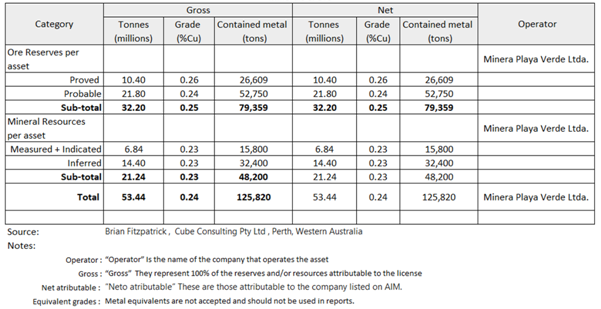
· Substantial JORC Code (2012) Mineral Resource base with declared total Mineral Resources of 53.44 million tonnes with an average grade of 0.24% Cu, in-situ fine copper content of 125,820 tonnes, which includes;
- The Ore Reserves; and
- 6.84 million tonnes of Measured and Indicated Minerals Resources plus 14.4 million Inferred Minerals Resources
· Declared Ore Reserves of 32.2 million tonnes with an average grade of 0.25% Cu, with an in-situ fine copper content of 79,359 tonnes.
- 10.4 million tonnes of Proved Ore Reserves with an average grade of 0.26% Cu and 21.8 million tonnes of Probable Ore Reserves with an average grade of 0.24% Cu
· NPV10 of US$154.1 million and an IRR of 50.9% (after tax) based on the Ore Reserves only (using US$ 5.30 per pound of Cu and US$ 4,300 per oz of Au)
· Initial Mineable Resources and Reserves of 34.2 million tonnes to produce 60,329 tonnes of refined copper
- Mine plan based on dredging and processing ~5.0 Mtpa of tailings
- Overall metallurgical recovery of ~72% Cu via dual SX-EW and flotation processes
- NPV10 of $164.1 million and an IRR of 51.4% after tax for the Initial Mineable Resources and Reserves (US$ 5.30 per pound of Cu and US$ 4,300 per oz of Au)
· Established license position and permitting status
- Six exploitation licenses covering 13.57 km2, held 100% by Minera Playa Verde Ltda (an indirect wholly-owned subsidiary of Halo)
- Exploitation licenses are of indefinite duration under Chilean law, subject to payment of the annual mining fee and compliance with legal obligations
- Environmental Impact Assessment process completed with unanimous approval of the Resolución de Calificación Ambiental (Environmental Qualification Resolution) granted by the Chilean Committee of Ministers in October 2025
· Established process route and mining method
- Dredge mining of non‑cohesive copper‑bearing tailings in a controlled pond configuration, designed by Royal IHC, with electric dredging wheel and backfill of reprocessed tailings into the dredged pond.
- Hybrid process plant combining flotation and acid leaching, followed by SX/EW for cathode production and flotation for concentrate, tailored to a mixed sulphide/oxide tailings mineralogy.
- Target products:
• Grade A copper cathodes (SX‑EW) - c.7,080 tpa
• Copper‑gold concentrate - c.7,800 dmtpa at ~20% Cu and 5.5 g/t Au.
· Significant upside potential from resource growth
- Current JORC Mineral Resources and Ore Reserves cover the beach (onshore) tailings only
- Historical bathymetric and subsea drilling data indicate substantial volumes of mineralised tailings in the surf and bay zones (submarine areas not yet included in the JORC model)
- CPR notes that, subject to further drilling, sampling and regulatory approvals, incorporation of submarine tailings has the potential to increase the Mineral Resource base by up to ~200% relative to the current estimate.
Andrew Dennan, Chief Executive Officer comments:
"We are very pleased to announce the results of this independent CPR, which confirms a substantial JORC-compliant resource and reserve base at Playa Verde, together with robust project economics and a well advanced mine plan. The CPR validates our view that Playa Verde is a technically sound and financially attractive copper project with significant upside potential from the broader bay and surf zones, and we look forward to advancing the Project towards development for the benefit of our shareholders and stakeholders in Chile."
Qualified Person
The information in this announcement that relates to Mineral Resources, Ore Reserves, mine planning, metallurgy and economic evaluation for the Playa Verde Copper Tailings Project is extracted from the Competent Person's Report prepared for Halo Minerals PLC by EMI‑Ingenieros y Consultores S.A., dated 12 February 2026. EMI are an independent Chilean mining engineering and consulting firm, with extensive experience in resource and reserve audits and feasibility-level studies. The CPR was compiled under the supervision of Mr Orlando Rojas Vercelotti, Civil Mining Engineer, a Competent Person as defined in the JORC Code (2012), who has sufficient experience relevant to the style of mineralisation and type of deposit under consideration and to the activity being undertaken.
Mr Rojas Vercelotti has reviewed the information contained in this announcement, to the extent that it relates to the matters summarised from the CPR, and has consented to the inclusion of such information in the form and context in which it appears.
Enquiries:
| Halo Minerals PLC |
Via Tavistock below
|
| Andrew Dennan, Chief Executive Officer Frank Jackson, Chief Financial Officer |
|
| |
|
| |
|
| Global Investment Strategy (Broker)
Christopher Kipling |
+44 20 7048 9045 |
| |
|
| Tavistock (Public Relations) |
+44 20 7920 3150 |
|
Josephine Clerkin Gareth Tredway |
|
Notes to Editors:
Halo Minerals PLC is the 100% owner of the Playa Verde project, an advanced copper tailings project focused on reprocessing metal rich historic tailings which have accumulated onto a beach located in the Atacama region of Chile. The project is a technically de-risked and recently received unanimous EIA approval from the Chilean Government's Ministerial Committee.
Playa Verde has a JORC compliant resource of 53.4 Mt @ 0.24% Cu, which includes reserves of 32.2 Mt @ 0.25% Cu, and is updating its DFS for dredging and retreatment initially targeting the reserves of ore located on the beach followed by up to a further 21 Mt of ore contained in the western berm and shoreline area. The project is well placed with significant upside in securing the rights to process up to a further 121Mt of offshore resource which originated from the same historical mining operations as the onshore resource.
Halo Minerals plans to advance the Playa Verde project on an accelerated timeline to production with funds raised expected to take the project to a final investment decision. Financial analysis estimates operating costs of only $2.19 per pound of copper produced, with the processing of the reserves having an NPV10 of US$ 154.1 million and an IRR of 50.9% after tax from a 7 year life of mine to produce the 32.2 Mt of reserves (based on static commodity price assumptions of $5.30/lb Cu and $4,300/oz Au).
The Company's philosophy is "Mining with a difference" working with the community to detoxify the region, returning the re-treated beach back to the local community whilst economically producing key strategic and battery metals to the benefit of all stakeholders.
JORC Mineral Resource & Ore Reserves
Geology of the Mineralised Tailings Deposit
The area of interest of the Playa Verde Copper Tailings Project presents unique geological conditions, as it is made up of weathered and dispersed tailings from a porphyry copper complex located more than 120 km to the east. These materials originated in the mines of Potrerillos and El Salvador, whose tailings were discharged between 1938 and 1978 in Chañaral Bay through a pipeline installed in the bed of the Salado River.
During that period, mining waste management was carried out with much less stringent standards than today. Initially under the operation of the U.S. company Andes Mining Company between1938 - 1973, and later under state owned company Codelco from 1973 - 1978, the tailings were dumped directly into the sea, generating a sedimentary plume that expanded from the discharge point north of the municipality of Chañaral.
This process resulted in a displacement of the coastline of up to 1,000 m to the west and the accumulation of 10 to 15 m of stratified tailings on top of the original sediments. It is estimated that the total volume deposited reached 250 million tonnes, covering approximately 13 km² of surface, both on land and in the marine area. Since then, these tailings have been exposed to the combined action of waves, wind and chemical processes for more than four decades, modifying their composition and surface structure.
The mineral composition reflects the alteration and mineralisation processes of the original deposits. In Potrerillos, three hypogenous events and a supergene enrichment zone are distinguished, with potassium and propylitic alterations that provide potassium feldspar, biotite, chlorite, quartz, ankerite and anhydrite, along with sulphides such as chalcopyrite, bornite, pyrite, molybdenite and traces of enargite, sphalerite and galena. In El Salvador, early mineralisation is characterised by quartz veins and K-silicate assemblages with alkali feldspar, biotite, anhydrite, chalcopyrite, bornite, and pyrite. The alteration transformed hornblende into biotite and minerals such as anhydrite, rutile and ilmenite into hematite, while secondary sulphides (chalcocite and covellite) largely replaced chalcopyrite and bornite.
Both mines were exploited underground and their tailings were generated by collective flotation of Cu-Mo sulphides, conditioned with lime at pH 10.5. The tailings travelled about 120 km along the open course of the Salado River to Chañaral, where small miners also added chemicals uncontrollably in their copper recovery operations.
The current material in the bay consists of fine light grey sands (>50% - 160 μm), with fragments of shells and rounded gravel, overlying the original darker beach deposits. The main copper-bearing minerals are: chalcopyrite, bornite, covellite, chalcocite, malachite, chrysocolla/brochantite and molybdenite. The gangue minerals correspond mainly to quartz, with lower proportions of ilmenite, magnetite and pyrite. Chalcopyrite occurs both as inclusions in quartz grains and in released fine particles.
The local geology of Playa Verde is defined by its artificial and anthropogenic character, a direct result of the historical deposition of tailings from Potrerillos and El Salvador. This unique context differentiates the project from natural deposits, giving it relevance in both technical and environmental terms, as it constitutes a mining liability transformed into a potentially exploitable resource.
Minerals Resources and Ore Reserves
The Minerals Resource and Ore Reserves for Playa Verde project as at 12 February 2026 is given in the table below. EMI considers that the Mineral Resource and Ore Reserves Statement as presented is reported in accordance with the JORC Code (2012).
Resource and Reserve Growth Potential
The mineral resource estimate for Chañaral covers the beach area only, but there is significant potential for augmentation through the future incorporation of mineralised material in the surf and bay zones, subject to regulatory approvals from the Chilean government. Analysis of historic subsea drilling data and bathymetric modelling were not part of the scope of the current model. However, the WAI report (2014) includes a summary of the "potential" estimate made by NCL Ingeniería y Construcción S.A. in July 2008, which considered the Bay, Surf-zone and Beach areas. The potential for resource growth at Chañaral lies in the future incorporation of the submarine zones (Bay and Surf-zone), where previous estimates suggest significant volumes of mineralised tailings, which could be 200% of the current mineral resource base if confirmed by further exploration and sampling campaigns.
Ore Processing
The metallurgical testing program was designed with the goal of maximising copper extraction from tailings, generating marketable products and environmentally safe waste that allows for the rehabilitation of the current beach. To achieve this, a hybrid process was developed that combines flotation and leaching technologies, taking advantage of each method according to the predominant mineralogy.
The basic process concept for the Playa Verde Project was developed within the framework of the Pre-Feasibility Study. At the time of the deposition of the tailings in the bay, the remaining copper was mainly in the form of sulphides, almost exclusively as chalcopyrite. However, over the years, weathering and oxidation processes have transformed approximately 60% of copper into acid-soluble oxides and chlorides, according to tests carried out by MPV.
From a metallurgical point of view, copper sulphides respond efficiently to concentration by froth flotation but show low recovery by acid leaching. In contrast, copper oxides and chlorides exhibit an inverse behaviour: low flotation efficiency, but high solubility and recovery by leaching.
Extraction of the ore
The extraction of the ore (tailings) will be done through dredging. The design leans into the non-cohesive nature of tailings, allowing passive excavation with an electric dredging wheel. The multi-lane pond configuration ensures stability, efficiency and operational continuity, although it implies the need for dividing berms that carry risks of ore loss or dilution. The final scheme achieves a balance between technical feasibility, extraction efficiency and control of operating costs.
The company Royal IHC was contracted by Copper Bay to evaluate the feasibility and operational parameters of the recovery of tailings by dredging in Chañaral Bay. The design of the dredging is based on key factors: material cohesion, excavation tool, dredging depth, equipment manoeuvrability and selectivity of extraction.
Production Program
The production program was developed considering a consolidated copper tailings extraction of 5.0 million tonnes per year (5.0 Mtpa). The initial position and direction of the dredging were determined in the initial stage of this study using the previously calculated net value attribute for the blocks of the Block Model.
Table 1. Production Program

The initial mine plan tonnage for the Playa Verde Copper Deposit amount to 34.20 million tonnes with an average grade of 0.25 %Cu. It is clarified that the 34.2 million tonnes refers to production (material extracted) and includes the majority of the Ore Reserves and 2.6 million tonnes of Inferred Resources. From a Mineral Reserve reporting perspective, these Inferred Resources are not declared as such and are deducted from the Mineral Reserves, applying a conservative approach and in accordance with the JORC Code (2012).
Economics Analysis
Within the framework of the economic analysis of the project, a NPV10 of US$ 164.1 million after taxes and an IRR of 51.4% were estimated.
The exercise is based on the following main assumptions:
· Total Mineral Resources: 34,821,000 tonnes.
· Copper content: 83,790 tonnes.
· Total copper production: 60,329 tonnes.
· Project lifespan: 7 years.
· Material dredged to full production: 5 million tonnes per year.
· Copper production at full capacity: 8,640 tonnes per year.
· Copper price: US$5.30 per pound.
· Gold price: US$4,300 per ounce.
Considering only the Ore Reserves declared in the CPR (32.2 million tonnes @ 0.25% Cu) the project's financial results indicate a Net Present Value at a 10% discount (NPV10) of US$154.1 million and an Internal Rate of Return (IRR) of 50.9%.